Systems
Once we had decided on the boat's colours, woodwork, floors, and work surfaces, the subject of options raised it's ugly head! There were things that we knew we wanted to improve the autonomy of the boat; things like a generator, and watermaker but making the final decisions isn't quite as easy as saying "we will have that and that".
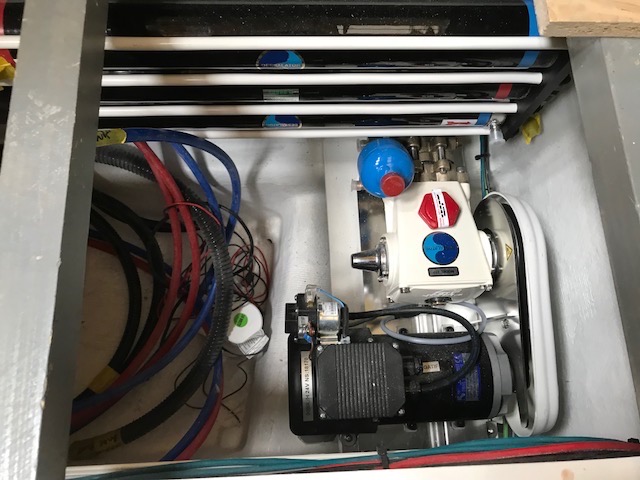
The watermaker is a big power user so we wanted to maximise output while power was available - either motoring or while running the generator. We ended up going with Discovery's recommendation of a Dessalator unit, as they have good experience with this brand on the original Discovery yachts. The model chosen was the Freedom 100, producing 100L/Hr.
The main water tank is just over 400L, but we had an additional 200L tank fitted in the bow. Anyone who has cruised extensively will know what a pain laundry can be, so we specified a small ( 3Kg ) washing machine that we know had been fitted to the Southerly 47 in the past.
One of the destinations in our plans is the Mediterranean so we definitely wanted air conditioning, so more decisions to make; central chiller or discrete units. Thinking this through, we went for three discrete A/C units, which gives us a degree of redundancy in the event of a failure.
Going for air conditioning had an impact on the choice of generator, the 'standard' option was for a 5KW unit but we were advised to upgrade this to 6KW to allow for the A/C.

The electrical system was a no brainer. Steve, the electrical manager tentatively suggested a 24V system by Mastervolt ( the standard boat is 12V ), I was delighted by this as 24V has many advantages on a complex power hungry boat, and Mastervolt equipment has a good reputation for reliability.The battery bank was expanded to 4 X 225A/Hr 8D batteries, giving a service bank capacity of 450A/Hr at 24V, this gives us plenty of capacity to run the electric winches and a big ( 3.5KW ) inverter. A bow thruster was a standard fitment but we went with a stern thruster as well as the twin rudders don't allow any prop wash for manoeuvring.

The main engine we were quite happy with. This is a Yanmar 4JH80, 80HP common rail diesel. There were a few modification that we wanted but weren't possible from a warranty point of view. The drive chain was improved with the addition of an Aquadrive drive shaft which takes thrust loads off the gearbox and eliminates the requirement for accurate alignment of the propeller shaft with the gearbox. The standard specification for the boat includes two fuel tanks totalling 660L which we feel will give plenty of scope for running all the systems and allowing a long motoring range if the wind dies completely - apparently many Biscay crossings consist mainly of motoring or motor sailing!
The navigation system was always going to be a moving feast as ( like computers ) things develop so quickly. We have been happy and comfortable with the Raymarine system on the current boat so at least that was one decision made. The staff on the Raymarine stand at the Southampton boat show were well interrogated and we had a fairly reasonable idea of the general layout of the system we wanted when we sat down with Steve, and Ben from Greenham Regis to thrash out the final shape of the system.
One of the first modifications I made to the current boat was to add davits to hang the dinghy from, this has been a big success and we didn't take any persuading to fit davits to Kered. The davits fitted have a capacity of 175Kg so we can have a 3m aluminium hulled RIB with a 10HP outboard and stay comfortably within capacity.
We wanted to have a selection of renewable power options available, and have ended up fitting a hydro-generator to produce power while we are sailing, a wind turbine, and solar panels mounted on the coach roof and bimini. We might have an engine with a big alternator and a generator, but we don't want to run these underway or in a peaceful anchorage unless we need to. These renewable options should cover our power requirements 90% of the time.
I am sure that there are lots more items but I think this gives an idea of what the boat is like under the skin.
We are now approaching launch day which will be followed by about 2 weeks of commissioning. Once we take formal delivery we will spend a week or so in the Solent area making sure everything is working ( and we know how to work everything ) - Then the fun begins!
The watermaker is a big power user so we wanted to maximise output while power was available - either motoring or while running the generator. We ended up going with Discovery's recommendation of a Dessalator unit, as they have good experience with this brand on the original Discovery yachts. The model chosen was the Freedom 100, producing 100L/Hr.

Dessalator Freedom 100 watermaker.
The main water tank is just over 400L, but we had an additional 200L tank fitted in the bow. Anyone who has cruised extensively will know what a pain laundry can be, so we specified a small ( 3Kg ) washing machine that we know had been fitted to the Southerly 47 in the past.
One of the destinations in our plans is the Mediterranean so we definitely wanted air conditioning, so more decisions to make; central chiller or discrete units. Thinking this through, we went for three discrete A/C units, which gives us a degree of redundancy in the event of a failure.
Going for air conditioning had an impact on the choice of generator, the 'standard' option was for a 5KW unit but we were advised to upgrade this to 6KW to allow for the A/C.

Cummins Onan MDKBJ 6KW generator.
The electrical system was a no brainer. Steve, the electrical manager tentatively suggested a 24V system by Mastervolt ( the standard boat is 12V ), I was delighted by this as 24V has many advantages on a complex power hungry boat, and Mastervolt equipment has a good reputation for reliability.The battery bank was expanded to 4 X 225A/Hr 8D batteries, giving a service bank capacity of 450A/Hr at 24V, this gives us plenty of capacity to run the electric winches and a big ( 3.5KW ) inverter. A bow thruster was a standard fitment but we went with a stern thruster as well as the twin rudders don't allow any prop wash for manoeuvring.

Some of the extensive Mastervolt electrical system behind the starboard settee.
The main engine we were quite happy with. This is a Yanmar 4JH80, 80HP common rail diesel. There were a few modification that we wanted but weren't possible from a warranty point of view. The drive chain was improved with the addition of an Aquadrive drive shaft which takes thrust loads off the gearbox and eliminates the requirement for accurate alignment of the propeller shaft with the gearbox. The standard specification for the boat includes two fuel tanks totalling 660L which we feel will give plenty of scope for running all the systems and allowing a long motoring range if the wind dies completely - apparently many Biscay crossings consist mainly of motoring or motor sailing!
The navigation system was always going to be a moving feast as ( like computers ) things develop so quickly. We have been happy and comfortable with the Raymarine system on the current boat so at least that was one decision made. The staff on the Raymarine stand at the Southampton boat show were well interrogated and we had a fairly reasonable idea of the general layout of the system we wanted when we sat down with Steve, and Ben from Greenham Regis to thrash out the final shape of the system.
One of the first modifications I made to the current boat was to add davits to hang the dinghy from, this has been a big success and we didn't take any persuading to fit davits to Kered. The davits fitted have a capacity of 175Kg so we can have a 3m aluminium hulled RIB with a 10HP outboard and stay comfortably within capacity.
We wanted to have a selection of renewable power options available, and have ended up fitting a hydro-generator to produce power while we are sailing, a wind turbine, and solar panels mounted on the coach roof and bimini. We might have an engine with a big alternator and a generator, but we don't want to run these underway or in a peaceful anchorage unless we need to. These renewable options should cover our power requirements 90% of the time.
I am sure that there are lots more items but I think this gives an idea of what the boat is like under the skin.
We are now approaching launch day which will be followed by about 2 weeks of commissioning. Once we take formal delivery we will spend a week or so in the Solent area making sure everything is working ( and we know how to work everything ) - Then the fun begins!


Comments
Post a Comment