The Genesis of 'Kered'
Back in early 2017, we were at the Northshore Shipyard in Itchenor near Chichester, investigating getting some work carried out on our current boat, a Southerly 110. The shipyard was formerly Northshore yachts who build Southerly yachts until their final demise in 2014. We both commented on how sad it was that Southerlies were not being built anymore, and that the hull moulds were left outside in the elements where they were clearly degrading. At about this time we became aware that Paul and Sheryl Shard from Distant Shores TV ( www.distantshores.ca ) were investigating getting a new yacht built to replace their Southerly 49 'Distant Shores II'. The comments they posted suggested that what they were looking at sounded suspiciously like a NEW Southerly! It became clear that they were working with Discovery Yachts, and when they announced an open yard event that they would be present at, our curiosity led to us making an appointment for a chat. Well, when we talked to Paul and Sheryl it was clear that they were working with Discovery to resurrect the Southerly 47 in a modified form and that Discovery were in the process of acquiring the rights to the whole Southerly brand. One thing led to another and eventually we signed on the line - the rest, as they say, is history!
We were really excited about the opportunity to commission hull #2 and to have a boat that we were comfortable sailing further afield. We loved the flexibility of the Southerly swing keel system on our current boat which we sailed right round mainland UK (www.voyagesofnormanjames.blogspot.co.uk) , and to have this in a package that was significantly more autonomous was very attractive. With a generator and water maker onboard, coupled with a more powerful tender means that we only need to keep the fuel tanks full, and use the tender for provisioning if we don't want to go into a marina - there is nothing quite like a night in a peaceful anchorage away from all the noise a bustle that is usually present in a marina.
Many people ask about the name 'Kered', it is simply Sue's fathers name 'Derek' spelt backwards. It was Derek that instilled Sue's love of sailing from a very early age, and we thought that it was very appropriate to honour him in this way.
Kered's build commenced in October 2017 once 'Distant Shores III' was de-moulded and the mould itself prepared for the production of our hull.

Once the mould was prepared and waxed, the first operation was to apply the cavita and boot lines. At first it seemed a little odd to be asked to decide on the line colours and style at the same time as deciding the hull colour but it seems quite obvious, now that we have witnessed the build process, that the layup is from the outside in. The main hull colour is called 'night blue' which is not as dark as the name suggests; this is combined with a bright red cavita line ( the line just below the deck level ) and the top boot line ( just above the water line ). The bottom boot line is a very light cream which will also be used for the deck moulding.

The photo above shows the coloured area of the hull with the blue gelcoat in place, the lines are now hidden by the blue resin. The underwater section of the hull is not coloured at all, as clear gelcoat is less susceptible to water ingress with time. As can be seen from the photo, the moulding is started as two separate halves, this is to allow the build up the skeg which will protect the propeller when the boat is beached. Once sufficient layup has been made, the two halves are brought together and the layup continues as one piece ( minus the transom which is attached later ).

The photo above shows the hull with the keel box in place and the cored structure above the waterline, the core gives great stiffness to the hull and good insulating properties. The forward section is also reinforced with kevlar, and a watertight bulkhead will be installed behind this. The photo below shows the keel box moulding prior to being moulded into the hull.


The strengthening ribs are now being put into the hull, they are formed from closed cell engineering foam which is then laminated into the hull forming a very strong and stiff rib. The floor bearing rib is shown laminated in with the foam for some of the transverse ribs being placed near the bow.

The keel assembly for the 480 is quite an item, with a 4 tonne grounding plate married to the keel itself which weighs in at just over 2 tonnes. The swing keel system allows a minimum draught of 1m, increasing to 3.12m with the keel fully lowered. The system is driven by an electro-hydraulic system, with a back up manual pump.

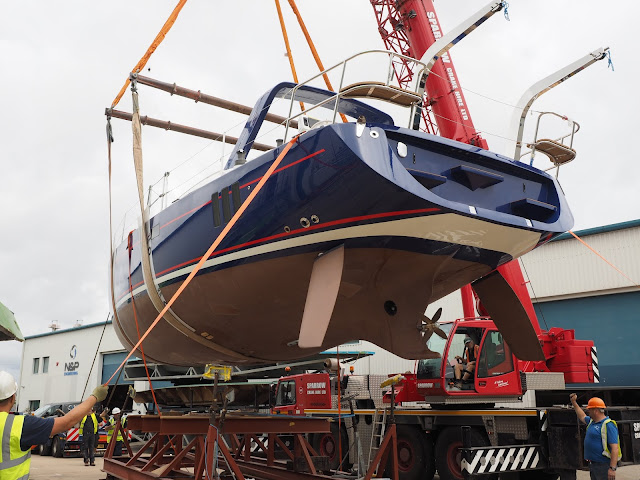
Hatching day! This is the moment the hull is revealed in all it's glory, and we knew that we had made good colour choices.

Above and below: Discovery Yachts has always been known for the quality of it's joinery, and it really was a pleasure watching the furniture develop and the pride of the the workers in what they were producing. The joinery shop is a happy marriage of modern CNC cutting processes, and traditional cabinet making techniques. Above is the stern cabin, and below, the galley module in build.

In the next post I will describe the fitting of the various mechanical and electrical systems which have been installed.
We were really excited about the opportunity to commission hull #2 and to have a boat that we were comfortable sailing further afield. We loved the flexibility of the Southerly swing keel system on our current boat which we sailed right round mainland UK (www.voyagesofnormanjames.blogspot.co.uk) , and to have this in a package that was significantly more autonomous was very attractive. With a generator and water maker onboard, coupled with a more powerful tender means that we only need to keep the fuel tanks full, and use the tender for provisioning if we don't want to go into a marina - there is nothing quite like a night in a peaceful anchorage away from all the noise a bustle that is usually present in a marina.
Many people ask about the name 'Kered', it is simply Sue's fathers name 'Derek' spelt backwards. It was Derek that instilled Sue's love of sailing from a very early age, and we thought that it was very appropriate to honour him in this way.
Kered's build commenced in October 2017 once 'Distant Shores III' was de-moulded and the mould itself prepared for the production of our hull.

Once the mould was prepared and waxed, the first operation was to apply the cavita and boot lines. At first it seemed a little odd to be asked to decide on the line colours and style at the same time as deciding the hull colour but it seems quite obvious, now that we have witnessed the build process, that the layup is from the outside in. The main hull colour is called 'night blue' which is not as dark as the name suggests; this is combined with a bright red cavita line ( the line just below the deck level ) and the top boot line ( just above the water line ). The bottom boot line is a very light cream which will also be used for the deck moulding.

The photo above shows the coloured area of the hull with the blue gelcoat in place, the lines are now hidden by the blue resin. The underwater section of the hull is not coloured at all, as clear gelcoat is less susceptible to water ingress with time. As can be seen from the photo, the moulding is started as two separate halves, this is to allow the build up the skeg which will protect the propeller when the boat is beached. Once sufficient layup has been made, the two halves are brought together and the layup continues as one piece ( minus the transom which is attached later ).

The photo above shows the hull with the keel box in place and the cored structure above the waterline, the core gives great stiffness to the hull and good insulating properties. The forward section is also reinforced with kevlar, and a watertight bulkhead will be installed behind this. The photo below shows the keel box moulding prior to being moulded into the hull.


The strengthening ribs are now being put into the hull, they are formed from closed cell engineering foam which is then laminated into the hull forming a very strong and stiff rib. The floor bearing rib is shown laminated in with the foam for some of the transverse ribs being placed near the bow.

The keel assembly for the 480 is quite an item, with a 4 tonne grounding plate married to the keel itself which weighs in at just over 2 tonnes. The swing keel system allows a minimum draught of 1m, increasing to 3.12m with the keel fully lowered. The system is driven by an electro-hydraulic system, with a back up manual pump.

Hatching day! This is the moment the hull is revealed in all it's glory, and we knew that we had made good colour choices.

Above and below: Discovery Yachts has always been known for the quality of it's joinery, and it really was a pleasure watching the furniture develop and the pride of the the workers in what they were producing. The joinery shop is a happy marriage of modern CNC cutting processes, and traditional cabinet making techniques. Above is the stern cabin, and below, the galley module in build.

In the next post I will describe the fitting of the various mechanical and electrical systems which have been installed.

Comments
Post a Comment